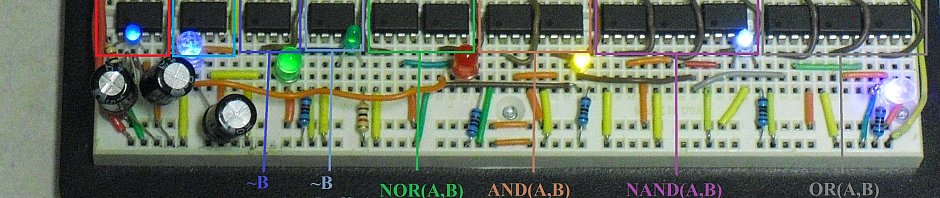
“Well, that takes a lot of the mystique out of Cisco routers…”
–Frank Gentges, AK4R (upon seeing one opened up)
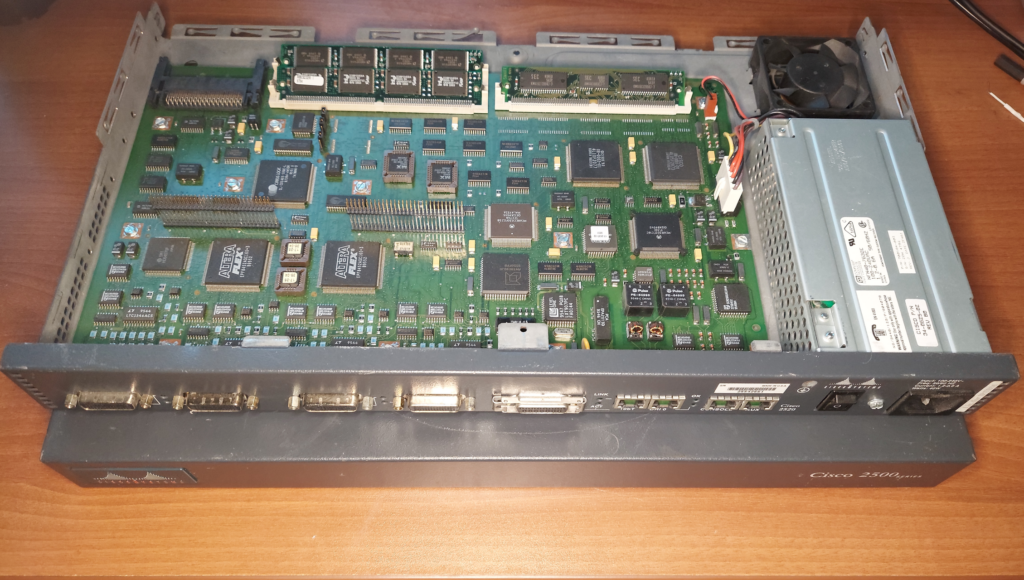
At one point, probably around the year 2000, it was said that every email (and anything else sent over the Internet) went through one or more Cisco routers. I believe it, at least given the market dominance Cisco enjoyed back in the early Internet days. No doubt, many exabytes of data have flowed through these Internet traffic-control devices.
IP routers are central to packet-switched networks. Working with routing protocols such as RIP and OSPF, they examine the addresses and subnet masks of incoming IP packets, and route those along to the next step. They would typically be paired with a CSU/DSU and connected to a 1.544 Mbit/sec T1 link (which was quite speedy for the time, but quickly got eclipsed once cable modems and fiber-to-the-home became popular. (Gigabit fiber is reasonably common in urban areas, today.)
Although the 2500 is (literally) a museum piece today — its 10BaseT Ethernet connection would be a huge bottleneck even for home Internet connections — the same important job is still being handled by thousands of similar, higher-speed devices. Packet-switched networks (of which the Internet is the poster-child example) do not create persistent electrical connections between nodes which need to communicate with each other. Instead, data is grouped into packets, which are routed node-to-node until they get to their destination.
(This particular router was pulled from service because it developed a problem with its persistent memory, and therefore won’t remember any settings. The company I was contracting for said to keep it.)
