One favorite hobby of mine is visiting flea markets and antique stores, looking for inexpensive and weird pieces of technology, and figuring out what they do. The Mystery Telco Box is a good example; I knew it would be interesting but had no real idea what it did. (It’s a monophone power unit.)
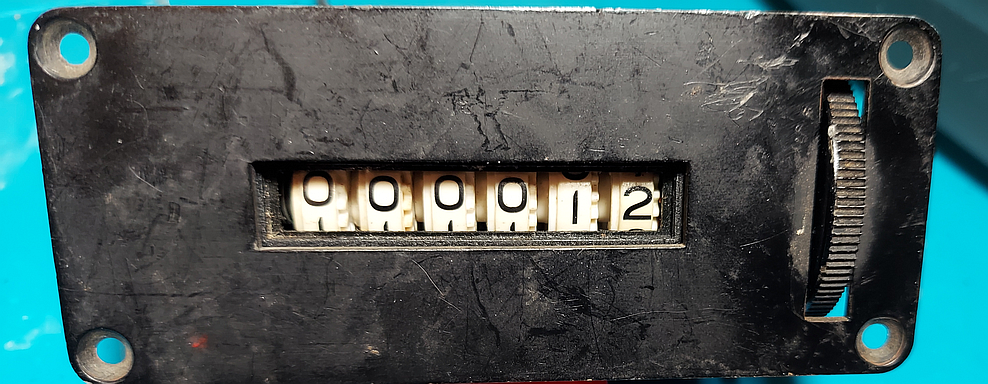
Another gizmo bought roughly around the same time is a Veeder-Root device with a six-digit counter on it. The only control visible is a digit-reset wheel, which seemed to work correctly. It was clearly either a counter or timer — hard to tell which. (It could easily be based on a 60Hz AC motor, or could count pulses.)

The manufacturer’s plate, showing the model and expected voltage.
Still doesn’t directly say what it is. (I could look online, but that’s cheating…)
It wasn’t immediately obvious how to open it, other than removing the front cover plate. Loosening the four screws around the connection wires just seemed to loosen an internal piece, so I put them back in place.
Eventually, I noticed a drop of dried pitch in the middle of one side. Scraping it off revealed a flat-blade screw (the only mainstream choice worse than Phillips.) It came out with a minimum of fuss (for once), allowing the two halves of the cover to be removed. Pretty slick design, honestly.

Now that the mechanism was visible, the device could be seen to be a counter. Two electromagnets work in tandem to pull a metal bar to advance the count. (The only problem was, manually pushing on this bar didn’t quite advance the count — the mechanism was out of adjustment.)

A little experimentation revealed the problem — the bar was being pulled to the electromagnets correctly (good — I really didn’t want to re-wind the coils), but wasn’t being pushed back far enough by the spring to catch the next digit.
Veeder-Root helpfully provided a set screw for this function (and another for the backstop). By turning it almost to the end of its travel, I was able to get it to tension the spring enough to push the plate back in place, allowing a complete count. But we’re out of set screw at this point — if it fails again, it needs a new spring (or for this spring to be uncompressed a bit.)

This counter will probably be a static museum display piece, so I don’t need it to be reliable. (Otherwise, I’d have replaced the spring.) But it’s working now, and (at least with a new spring) should keep on working for another eighty years or more.
