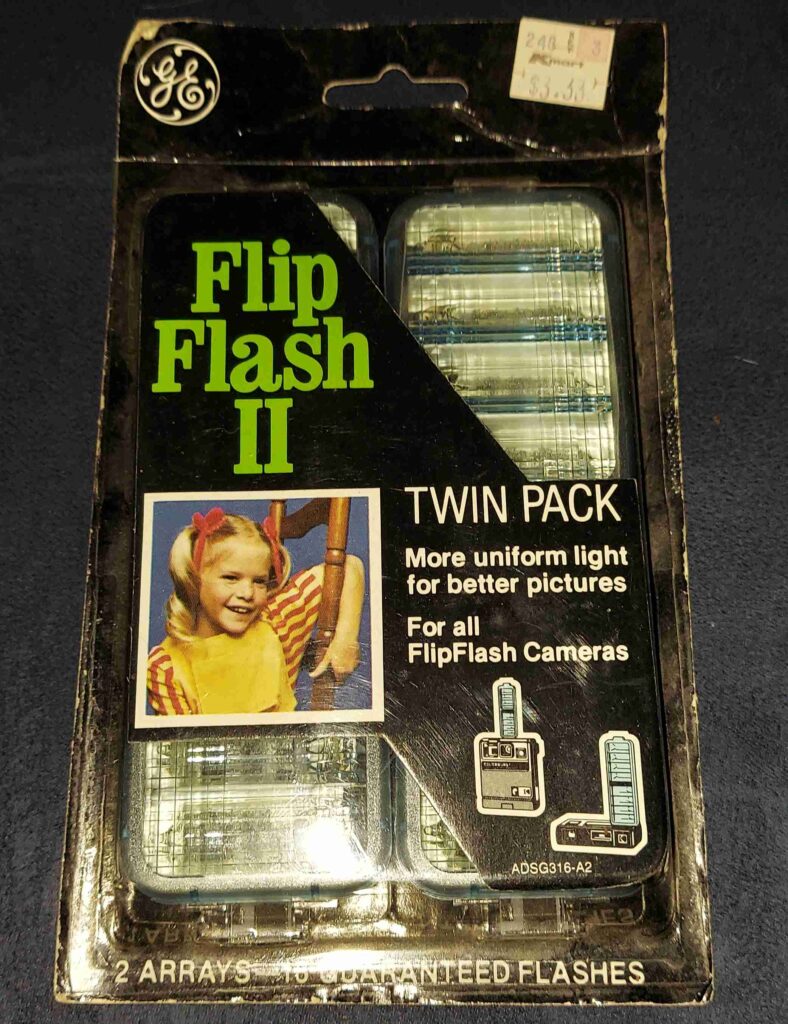
(You got four flashes per side, then flipped it over to use the other four.)
Taking pictures used to cost actual money.
Even today, you do still need a camera — but we all have smartphones with us anyway. Back in the day, you not only needed the camera, but needed to buy film and then either have it processed (for more money) or process it yourself in a home darkroom (which cost a lot of money to set up and then more for the materials.) Most people paid to have the pictures developed — FotoMat huts were a common sight in shopping center parking lots. Polaroid pictures were self-developing, but also more expensive and couldn’t be used for slides.
Even the lighting was often consumable. You could usually take daylight pictures outdoors using ambient light, but taking pictures indoors usually needed extra light. Professional photographers would lug around large umbrella lights with xenon strobe bulbs and exotic chargers that whined after every flash.
The consumer option was a lot more convenient — but a lot more expensive per shot, over time. A multiple-shot flash cartridge was designed, where a stored electrical charge from the camera would trigger a controlled explosive reaction between fine zirconium wire and a pure oxygen environment, resulting in a brief, bright flash of light.
The reaction consumed the filament and oxygen, ruining the bulb, but the genius idea was to harness the heat from this reaction to sever the connection to the currently-firing bulb, and also to enable the connection to the next bulb in the chain, so it would fire with the next picture taken. Although each individual bulb was single-use, you could take four (or five) pictures in a row, and then flip the flash cartridge over (thus the name) to use the others. Most FlipFlash cartridges came with colored dots on the back to indicate how many flashes remained.
Photo shops (and most drug stores and many grocery stores) sold these consumable flash cartridges — either the older Flash Cube style or Kodak’s Flip Flash, used on the 126 Instamatic and other cameras. For a few bucks, you could get a two-pack of flash cartridges, good for a total of sixteen flashes (not counting the occasional fairly rare misfire). That’s twenty cents per shot, in 1980s-era money, just to light up the shot. ($3.33 would buy lunch, back then.)
When I got my first digital camera in 1997, I calculated that it was roughly 600 times less expensive to take digital pictures and then burn them to a CD-R for storage, back then. The resolution back then didn’t compete with film — but it does, now.
Removing all effective cost per picture taken (as well the new ones being in digital form from the start) has not only allowed the explosion of multimedia social sites like Instagram and Facebook — it is a profound new tool to understand, record, and document our world. When students want a record of lab activities to include in the report, they simply take a picture and think nothing of it. 1980 would be amazed at how easy and inexpensive modern photography is.
