Finding myself teaching an introductory Circuits course without (at least as yet) an institutional MultiSim license, I was looking around for alternatives and came across CircuitJS, originally created by Paul Falstad.
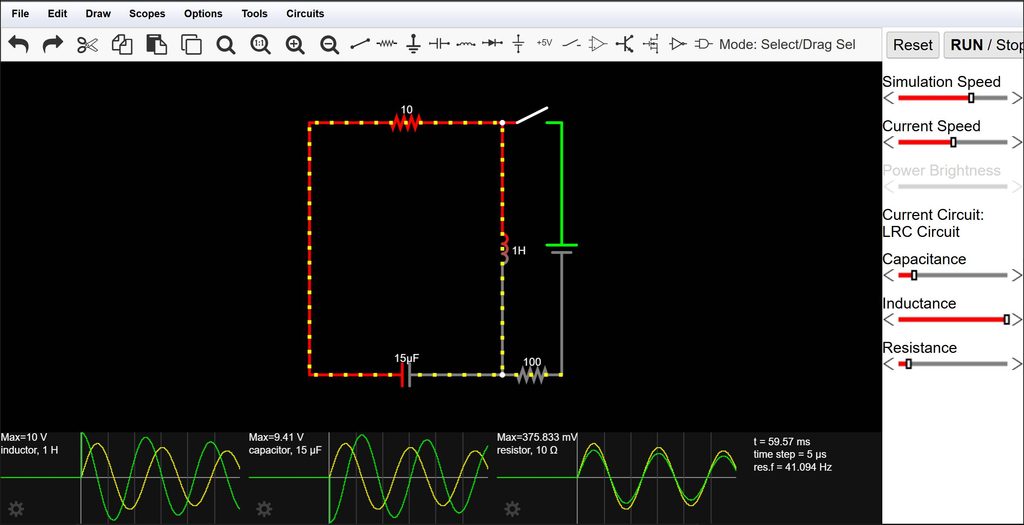
CircuitJS’ peculiar drag-to-draw-the-component placement style takes a little getting used to, but then again, so does MultiSim. Once you’re familiar with it, though, it’s easy to use (press R to place a resistor; press W to place a wire etc.) I’m not sure I’d use it for circuit analysis (we already have various flavors of SPICE for that anyway), but it’s certainly a very useful tool for education — particularly the way it allows for visualization of current flow using moving yellow dots and relative voltages using color (Green/Grey/Red). Students can build a circuit, see how the current flows through it, and then modify it dynamically and see the resulting changes.
The default LRC simulation provides a good example of this. The circuit starts off with an initially charged capacitor, which provides the energy to set a series LRC circuit oscillating. Energy is traded back and forth between the capacitor and inductor, with the resistor converting part of it into heat on every cycle. The resulting damped sine waves (voltage and current) can be seen in the analysis below the circuit, synchronized with the movement of the “electrons” in the wires of the schematic.
It’s even available as an open-source, downloadable JavaScript app.
