It works!

After a bit of debugging (some PIC code corrections, some VB code corrections, and finally tracking down a missing direction-pin wire), the Z80 computer is executing code! I wrote a short test program to compute Fibonacci numbers, and it ran correctly.

It still could use quite a few features — such as an internal clear-all-memory routine, program save and load functionality, program trace output, etc. But for now, it’s a working Z80 computer, accessed via RS232.

Posted in Digital, DrACo/Z80, Drexel | Leave a comment

Plus ça change…

…plus ça ne change pas. Or so they say, anyway — but the design of this computer has certainly changed. The changes are for the better, though: the core (which will be constructed by the students) has been greatly simplified, with as much functionality as possible having been collected into a control panel unit.

Here is the schematic for the “core.” Some more minor changes may yet happen (perhaps another 74LS245 for the control lines etc), but the core design is essentially finalized. The idea is that the core system can run as a “headless” unit, without a control panel: with the addition of 24 LEDs to show the status of the address and data lines, it should look like a real “Hollywood” computer, complete with blinking lights! I’m still skeptical about putting LEDs directly onto the busses, but we’ll see how that works out. If nothing else, they can be driven by three more ‘245s.

The control panel (still under construction) will include:

  • Rotary hex switches to enter addresses and data;
  • An LCD panel to read addresses and data (and perhaps other information);
  • Run/Stop, Single-Step, Manual/Auto, Reset, and Write switches;
  • An SD card slot and Load/Save switches to back up programs to an SD card; and
  • Three PIC microcontrollers to run all of this.

Right now, I’m creating a set of inter-MPU commands, to keep everything in sync. Complete details will be available here once it’s all finished.

Posted in Digital, DrACo/Z80, Drexel, PIC Microcontrollers | Leave a comment

I’m still here…

…I’ve just been busy working on some really cool paleotechnology projects. Dr. Rosen came across an article about a microprocessor course built around students creating their own 8086-based computer. He asked me what I thought about it — and my first thought was “Can I sign up, even though I’m not an undergrad?”

Since then, I’ve been working on coming up with a working computer design that EET students could have a chance of building in one ten-week term. (Drexel is on the quarter system.) Since nearly all modern PCs are based on x86 architecture, Dr. Rosen suggested that, like the course described in the article, we design the course around an 8086 computer. Here is the design. (Caveat lector: I haven’t completely built this one — let alone debugged the design. It almost certainly has multiple bugs. Consider it pre-alpha.)

Upon further reflection, Dr. Rosen pointed out that this design (rather complex, not to mention costing perhaps $250 in parts) was probably too ambitious for a one-term undergrad class. He asked what I thought we could do to simplify the design. I pared it down, removing the RS232 subsection and making a few other minor changes — but it became apparent to me that an 8088-based design would be significantly simpler and less expensive. Continuing this line of reasoning, I figured that a Z80-based design would be simpler still. (The Z80-based Timex-Sinclair 1000, after all, uses a total of only four ICs.)

Here is the Z80-based design. (Again, this has not yet been completely built, let alone debugged. Should we go with this design and build it, I will post complete plans here.)
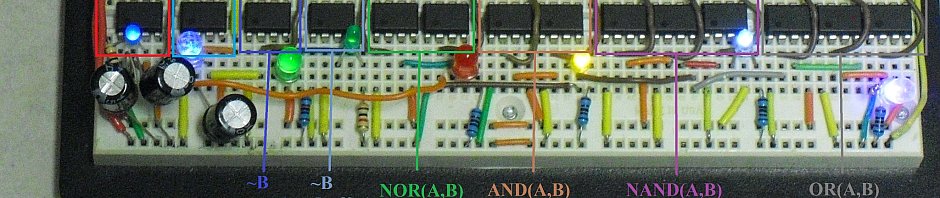

Posted in Digital, DrACo/Z80, Drexel | Leave a comment

Nothing but ‘Net

OK; I’m going to have to turn in my Paleotechnologist Card — or at least cross out the “Paleo” part — but this is pretty cool. I’m on the Amtrak, connected to the ‘Net via Internet sharing on my HTC Mogul — connected via Bluetooth PAN. Cool, especially using this connection to access my desktop back in PHL via Remote Desktop.

It seems to me that devices like the Mogul are the first of a new class of device. With connectivity via cell, WiFi, and Bluetooth, in addition to USB etc, it can handle cell phone calls, the usual Internet functions (POP, SMTP, HTTP, SSH, FTP yada yada) — and can also act as a router/NAT proxy. Not bad for a pocket-size gizmo.

Now if they could only improve the battery life. I wonder if it’ll make it to FBG?

Edit: Nope. The battery gave up just past Washington. It was fun while it lasted, though.

Posted in Current Events, Digital, Digital Citizenship | Leave a comment