Dirac Delta: Science and Engineering Encyclopedia

Wikipedia is a good source for general knowledge — but sometimes, more specialized information is needed. Dirac Delta is an interesting site, full of definitions and explanations of many scientific and engineering-related topics. (…and yes, they do have an entry on the Dirac Delta function.)


Posted in Resources | Leave a comment

Cracking the Capacitor Code

Small capacitors can sometimes be difficult to read. On large electrolytic capacitors, manufacturers often provide lots of specs, including not only a clear value (10uF, 220uF, etc), but rated voltage and sometimes other information, as well.

On smaller capacitors, this information is often quite terse. Larger ceramic and tantalum capacitors may still have the value written out in full (1uF etc) — but on smaller capacitors, space is at a premium and manufacturers resort to numeric shorthand to show values.

Typically, this shorthand will be one of several kinds:

  • Straight numeric value, with the unit assumed to be pF (picofarads);
  • Numeric value in pF with an “R” standing for a decimal (“2R2”);
  • Exponential format (described below).

The first two types are fairly straightforward — although the lack of standardization can lead to confusion.

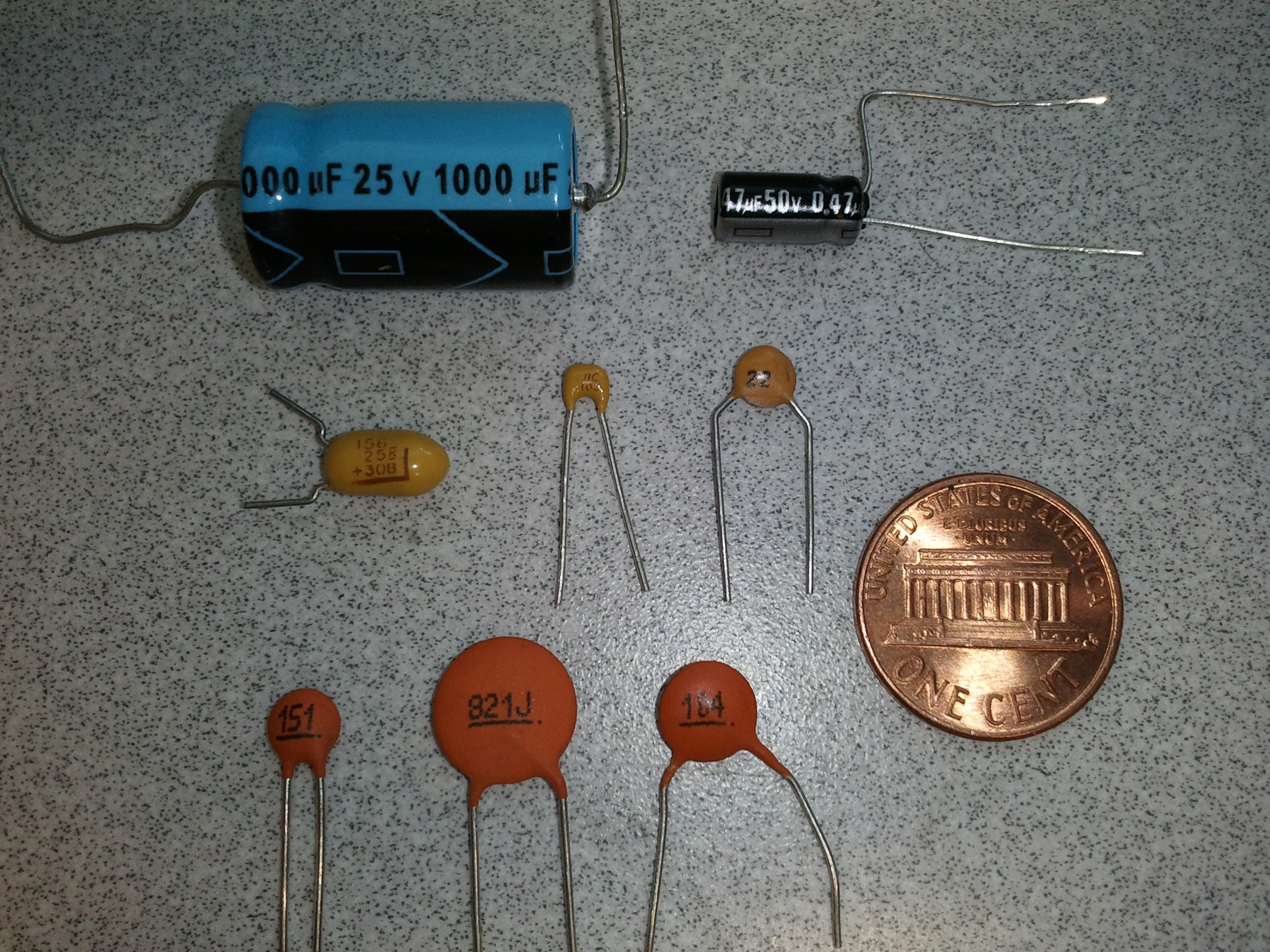
Various types of capacitors, most with cryptic markings. (Click for larger.)

As examples, the values of the capacitors in the above picture can be interpreted as follows (top to bottom, left to right:

  • 1000uF electrolytic (= 1mF; value shown directly)
  • 0.47uF electrolytic (value shown directly)
  • 15uF tantalum (15 x 10^6 pF = 15,000 nF)
  • 0.01uF tantalum (10 x 10^3 pF = 10 nF)
  • 22pF ceramic (value in pF marked directly)
  • 150pF ceramic (15 x 10^1 pF)
  • 820pF ceramic (82 x 10^1 pF)
  • 0.16uF ceramic (16 x 10^4 pF, or 160nF)

…of course, the most reliable way to tell for certain is to use a capacitance meter.
 

Posted in Analog, Components, Electronics, HOW-TO | Leave a comment

Bell Systems Technical Journals

There’s a lot of really good technical information out there on the ‘Net, if you know where to look. One excellent place to start digging is Alcatel-Lucent’s archive of the Bell Systems Technical Journals. The journals, which documented the work done at Bell Labs from 1922 to 1983, contain a gold mine of technical information, including quite a few historic, world-changing papers. Here’s a description, taken directly from the first (July 1922) issue.

Claude Shannon’s paper A Mathematical Theory of Communication is there — the paper that basically kick-started the whole field of information theory. A paper by Bardeen and Brattain on transistor physics is available, letting us hear about the discovery of the transistor directly from two of its inventors.

There’s even a paper from 1979 discussing how a new “cellular” phone system could work! What won’t they think of next?


Posted in Internet, Resources | Leave a comment

Accu-Feel: giving FSX a shot of realism

Sometimes, it’s the little things that really add to the experience.

Although it’s several years old, FSX is still a pretty decent flight simulator, especially with nice add-on aircraft like A2A‘s Boeing 377 with Accu-Sim or PMDG‘s Boeing 737 NGX. I’m a systems geek, so I appreciate the detailed systems modeling in the larger aircraft — from engine, fuel, and oil management on classic supercharged propliners like the 377 to long-haul computer-assisted navigation in state-of-the-art aircraft like the NGX. It still doesn’t always really feel like flying, though — but until just recently, I wasn’t sure just why.

Accu-Feel, an unassuming $14.99 add-on from A2A, changes that. It mostly models all of the subtle sounds associated with your flight. This doesn’t sound like much of an improvement — but it changes everything. Landing a Cessna in a crosswind no longer simply triggers a tire-screech sound. Instead, Accu-Feel’s code checks to see when and how each tire contacts the ground (and what type of ground it contacts), and dynamically generates sounds accordingly. Subtle cues like this really add to the experience in a big way. Accu-Feel models several other effects, as well, including pre-stall buffeting according to the wings’ dynamically-calculated angle of attack during flight.

Check out A2A’s video on the features of Accu-Sim — and if you’re a FSX enthusiast like me, you’ll end up wanting to try it for yourself. If so, you won’t be disappointed.

Posted in Digital, Flight Simulator, Reviews | Leave a comment