Cool (literally)

Electronics is at its most interesting when you come across something that truly seems magical. Making a webserver out of an Arduino comes close, as does building a computer from scratch — but it’s especially fun to experience something that seems to violate fundamental laws of physics.

The Peltier effect is one such “magical” piece of technology. Generally speaking, when current is run through a component, that component becomes warmer, as some of the electrical energy is radiated as heat. (This is what resistors do best.) Once you have designed enough devices, it becomes second nature to think about the heat generated; if you put five watts of power into a chip, you had better make sure there’s a way to remove five watts of heat at a temperature that won’t destroy the chip.

Now for the magical part. It turns out that certain solid-state devices can act as heat pumps when current flows through them. Overall, the device does become warmer, since like everything known to science, it operates at less than 100% efficiency. (A lot less than 100%, in this case.) However, when the current is passed through one of these Peltier devices, one side of the device cools noticeably. It’s science, yes — but science of a particularly magical flavor.

A medium-size Peltier device (without heatsink). Using Red as the positive lead will make the top the cool side; reverse the polarity to reverse the heat flow. (Click for larger.)

Peltier devices are notoriously inefficient for cooling, but they have some unique positive features. As solid-state devices, they are completely silent, quite reliable, and can be fit into small places. Their ability to cool below ambient temperature, silently and in a small form factor, is quite unique. They are used in some exotic CPU-cooling schemes (although air cooling is far more common and even water cooling and phase-change cooling are more widely used.) Peltier devices are especially useful for cooling CCD sensors for astrophotography, since CCD noise levels are best at low temperatures, and low noise is essential when capturing long-exposure images of very faint objects.

Peltiers, given a good heatsink/fan combination, can even produce temperatures below freezing…

An attempt at producing ice crystals with a Peltier device and heatsink+fan. (Click for larger.)


Posted in Components, Electronics, Science | Leave a comment

Cool math: Conway’s Game of Life

(This is the first of a planned series of articles on interesting topics in mathematics. Don’t worry, though; there won’t be a quiz. The whole idea is to show the fun side of math!)

One of the more interesting topics in math (for me, anyway) is emergent complexity. Often, very simple systems can lead to complex behavior. Fractals such as the Mandelbrot Set are a good example of this. Another example is Conway’s Game of Life.

Discovered / invented by Dr. John Conway in 1970, Life is a specific cellular automaton: a set of rules for updating the states (“alive” or “dead”) of a rectangular grid of cells (Conway apparently did some early investigations using a checkerboard.) Starting from a given “seed” configuration, the following two simple rules are repeatedly applied (to all of the cells at once):

  • If a “live” cell has exactly two or three neighbors, it remains “alive” in the next generation. Otherwise, it “dies” (potentially to be reborn again later).
  • If a “dead” (or “empty”) cell has exactly three neighbors, it becomes “alive” in the next generation. Otherwise, it remains empty.

These two simple rules lead to all sorts of interesting behavior. Some configurations quickly die out; others quickly evolve into stable “still life” configurations. The most interesting ones, though, can drift away across the plane, grow without bound, or play out in a chaotic manner for hundreds or thousands of generations before becoming stable. Here are some examples:


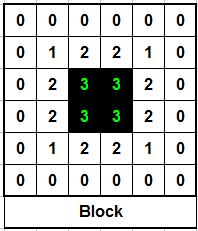
A “block” of four squares will remain exactly as it is — a classic example of a “still life”. Each live cell has three live neighbors; no empty cell has more than two — therefore, no cells ever die or are born.


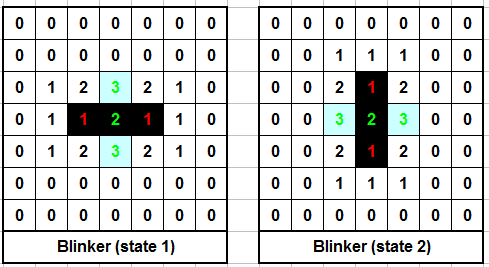
Three cells in a row will oscillate between horizontal and vertical configurations — becoming a “blinker.”


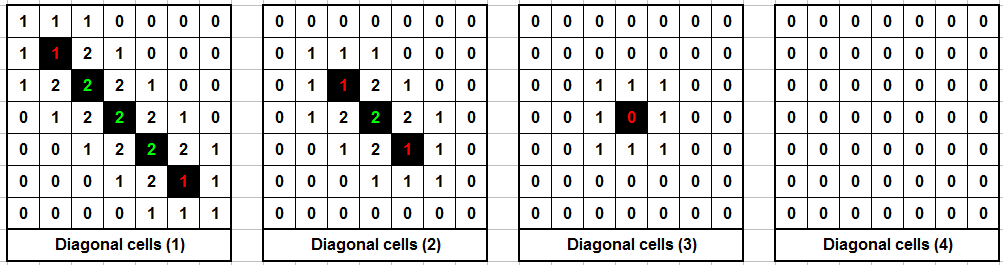
A diagonal row of cells will evaporate from each end…


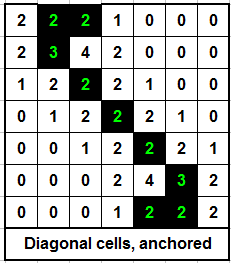
…but a diagonal row of cells “anchored” at both ends remains stable.


These are somewhat interesting — but the beauty of Conway’s Life is in the more complex behaviors it can produce:


Shortly after it was invented, the “glider” was discovered — which can move diagonally. (There are four versions, each mirror images, which move in the four diagonal directions.)


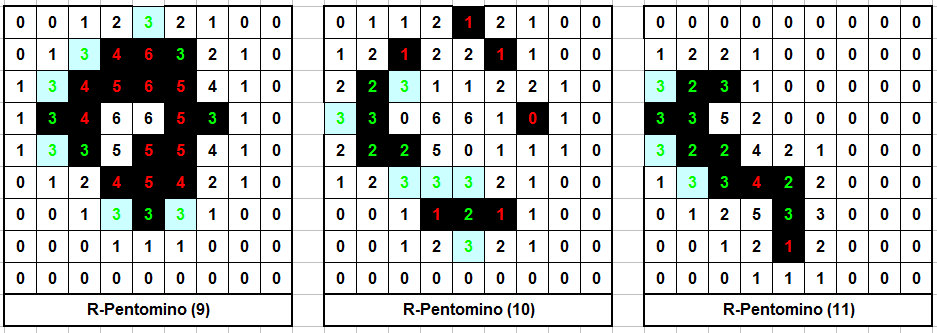
An excellent example of emergent complexity is the “R-Pentomino”: a set of five cells which explodes in a burst of activity, firing off several gliders until finally becoming stable over a thousand generations later(!)


There are many more interesting examples out there. In fact, it has even been proven that Conway’s Life can be used to build a universal (Turing-complete) computer — albeit a very inefficient one. I recommend Life32 as a good, easy-to-use program to start your investigations into Life. If you’re interested in finding out more about some of the many fascinating Life constructs discovered, Stephen A. Silver has compiled an excellent Life Lexicon.


Posted in Coding, Digital, Math, Science | 2 Comments

The Digital Revolution

By now, there is no doubt that we’re in the “Digital Age.” Everywhere you look, computers and other digital electronic devices are doing everything from carrying our telephone conversations to controlling our car engines to running our electronic toothbrushes.

Is this “digital” thing just another fad? Is this whole “Digital Revolution” just a way for manufacturers to sell us “upgraded” products, when the old ones would have worked just as well? What is “digital” anyway — and what benefits do we get from switching to “digital” technology?

There are plenty of important benefits — and it’s absolutely not an understatement to call digital technology a “revolution.” To understand why, it’s important to first understand the fundamental difference between “digital” technology and “analog” technology. Here is a brief explanation of what “digital” is, why it’s important, and (at a high level) how it makes the magic of the modern world possible. Sound recording is a good place to start.

In analog technology, signals (voltages or currents, in electronics) are continuously variable. An analog signal, for example, could range between zero and ten volts — or could take on any value in between. Zero volts is OK; ten volts is OK; so is 3.34523607 volts. None of these values necessarily have any special meaning in analog electronics — they generally correspond to, say, the audio waveform to be sent to a speaker. The sounds of a Beach Boys concert are picked up by a microphone and those “good vibrations” are transmitted, amplified but otherwise more or less unchanged, to a tape recorder.
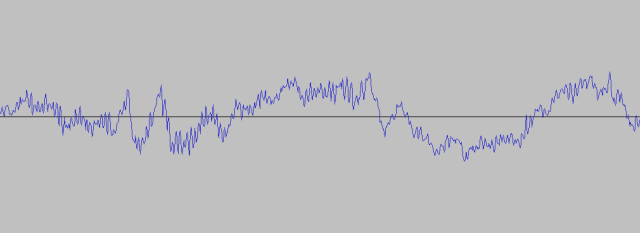
Part of a typical analog waveform (about 30 milliseconds of "Good Vibrations")

Digital technology works differently. Instead of a continuous range of possible values, digital values are limited to a finite set of possible values. For the most basic circuits, this is the familiar “zero” and “one” of binary arithmetic, represented as two specific values (say, zero and five volts) in a circuit. Values near zero (for instance, values up to 0.5 volts) are considered “low” (or “zero”), and values near five volts (say, anything over 4.5 volts) are considered “high” (or “one”). Values between 0.5 and 4.5 volts are not guaranteed to be either value, and should be avoided.
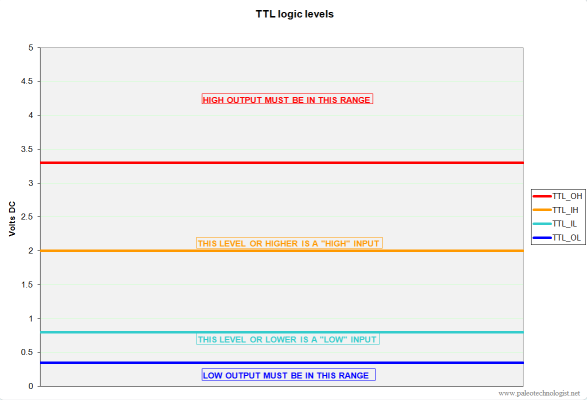
TTL voltage levels (click for larger)

Digital signals, therefore, are always either zero or one. Information is passed not by directly copying a microphone’s movements into changes in voltage, but by describing those changes using zero and one. Such descriptions using a small set of values have been around for years — the dots and dashes of Morse Code have been used for over 150 years! Similarly, every wire carrying a digital signal switches between “high” and “low” values, producing a waveform that looks very different from an analog signal…
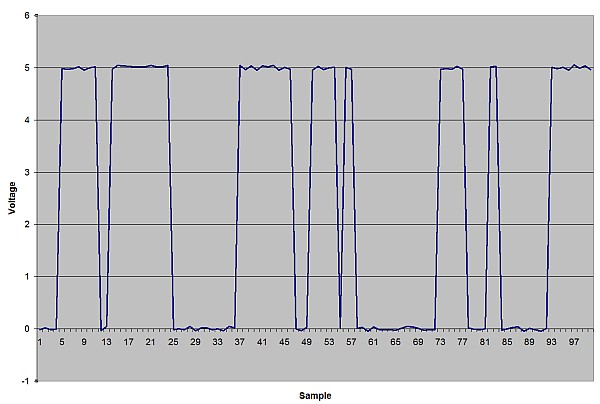
A (synthetic) digital signal, including a bit of noise. (Click for larger.)

At first, this seems very restrictive. How can you convey the delicate nuances of, say, a Chopin nocturne or the expansiveness and majesty of Tchaikovsky’s 1st piano concerto, if the music is broken up into little pieces like this?

The answer is that digital signals, although “zero or one” by themselves, can describe more complex signals. An analog signal from a microphone is “digitized” into a specific range of values. For music played by a CD player or typical mp3 player, sixteen bits per sample are used, meaning each sample of the signal is broken down into 2^16, or 65,536, possible values. A series of sixteen “bits,” each zero or one, is sent to represent each sample. Do this 44,100 times per second for each channel (left and right), and you have enough information to put the original signal back together almost exactly as it originally was. (If you want greater precision, use more bits and/or sample the signal more times per second. DVD-audio players can play back 24-bit music with up to 192,000 samples per second.)

This is much more accurate than any amplifier or speaker could ever hope to reproduce, by the way, despite what some audiophiles say. Discussions about the minutiae of amplifier design aside, there is no good reason to categorically dismiss digital recording technology. Use enough bits of precision and a fast enough sampling rate, and something else in the chain (the speakers, the wire, human ears, etc) will become the weak link.

With this understanding of what digital technology is, the benefits are easier to describe. The central point of digital technology is that it can describe any information — music, temperatures, Shakespearian sonnets, pictures, videos, etc. — as bytes (standardized, 8-bit characters). This seemingly trivial point is the key to all of the digital magic of the past few decades. Once a piece of information (say, a song) has been digitized, it can be treated like any other piece of information. It can be copied over and over — perfectly, without any degradation whatsoever. It can be emailed, stored for later use on a hard drive, archived, made searchable, analyzed, used as a ringtone, shared (I won’t get into legalities here), and played back over a network. All of this is possible because, to a computer, there is no difference between the characters that make up this song and those that make up an email, spreadsheet, database, program, or picture.

If signals were stored in analog format, specific conversions would have to be performed on each type of signal (audio, video, etc), before they could be copied to another computer, sent over a network, etc. Once information has been digitized, however, it is all fundamentally a series of bytes — and can easily be stored, recalled, transported, encrypted, decrypted, combined, analyzed, and sorted. Without this functionality, the Internet wouldn’t be possible in anything resembling its current form.

That’s what makes the “Digital Revolution” revolutionary — and that’s why it’s so important.
 

Posted in Analog, Audio, Digital, Digital Citizenship, EET205, EET325, Electronics, Fundamentals, Math | Leave a comment

Intercalatory Interpolation

Calendrics — the science (and art) of calendar creation — can be fun. Our traditional timekeeping system includes various units of time: seconds, minutes, hours, days, weeks, months, and years — but not all of these correspond to observable phenomena or always line up nicely with each other.

Each February 29th provides a nice opportunity to take a step back and look at the specifics of the current Western calendar — the “Gregorian calendar.” Our current calendar is a subtle-but-important modification of the previous (Julian) calendar. The modifications, made by Pope Gregory XIII, no doubt on the advice of astronomers, were designed to make a one-time correction to the calendar to realign dates with their proper respective seasons, and to make a subtle lasting change to the number of leap years so that the calendar would not continue to drift (at least as rapidly).

We define a solar day as the time it takes for the sun to return to the same apparent position in the sky. It takes a bit more than 365 of these solar days (one tropical year) for the Earth to go around the Sun once, returning the Sun to the same apparent place with respect to the background of stars. With just basic astronomical observations over the course of a few years, it was determined in antiquity that every fourth year needed to be one day longer to keep things in sync. This, plus the almost-but-not-quite-even splitting up of the year into the months we are familiar with, became the Julian calendar (named after Julius Caesar).

The Julian calendar worked fairly well, but by 1582, the year was some ten days out of sync: the equinoxes occurred some ten days earlier than their traditional, expected time. The Gregorian calendar, implemented by fiat by Pope Gregory and slowly adopted by non-Catholic nations (since it also happened to make good mathematical sense), subtly modified the Julian calendar as follows:

  • Every year divisible by four is a leap year, except
  • Every year divisible by 100 is not a leap year, except
  • Every year divisible by 400 is a leap year.

Therefore, 1900 was not a leap year, but 2000 was. (There won’t be another millennial leap year until the year 4000.)

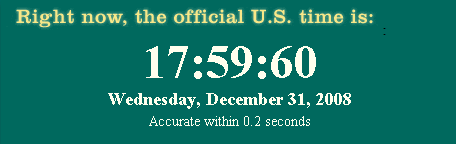
This scheme keeps the calendar closely enough in step with the Earth’s movement through space that the largest errors are now due to the gradual slowing of the Earth’s rotation. This has led to the modern (and somewhat controversial) practice of adding “leap seconds” to civil time, as required by variations in the Earth’s rotation. Leap seconds work similarly to leap days: every so often, the final minute of June 30 and/or December 31 is lengthened by one second:   23:59:58  –>  23:59:59  –>  23:59:60  –>  00:00:00 .

Some minutes have 61 seconds...

As for me, I’m definitely in favor of leap seconds. They’re a nice solution to the problem of small-scale calendric drift, and add a bit of statistical excitement to the subject, as well. If the Powers That Be are in an abolitionary mood, though, they could always do us a favor and get rid of Daylight Saving Time.


Posted in Math, Science | 2 Comments